
6 tips for memorizing your first page of the Quran
More isn't better

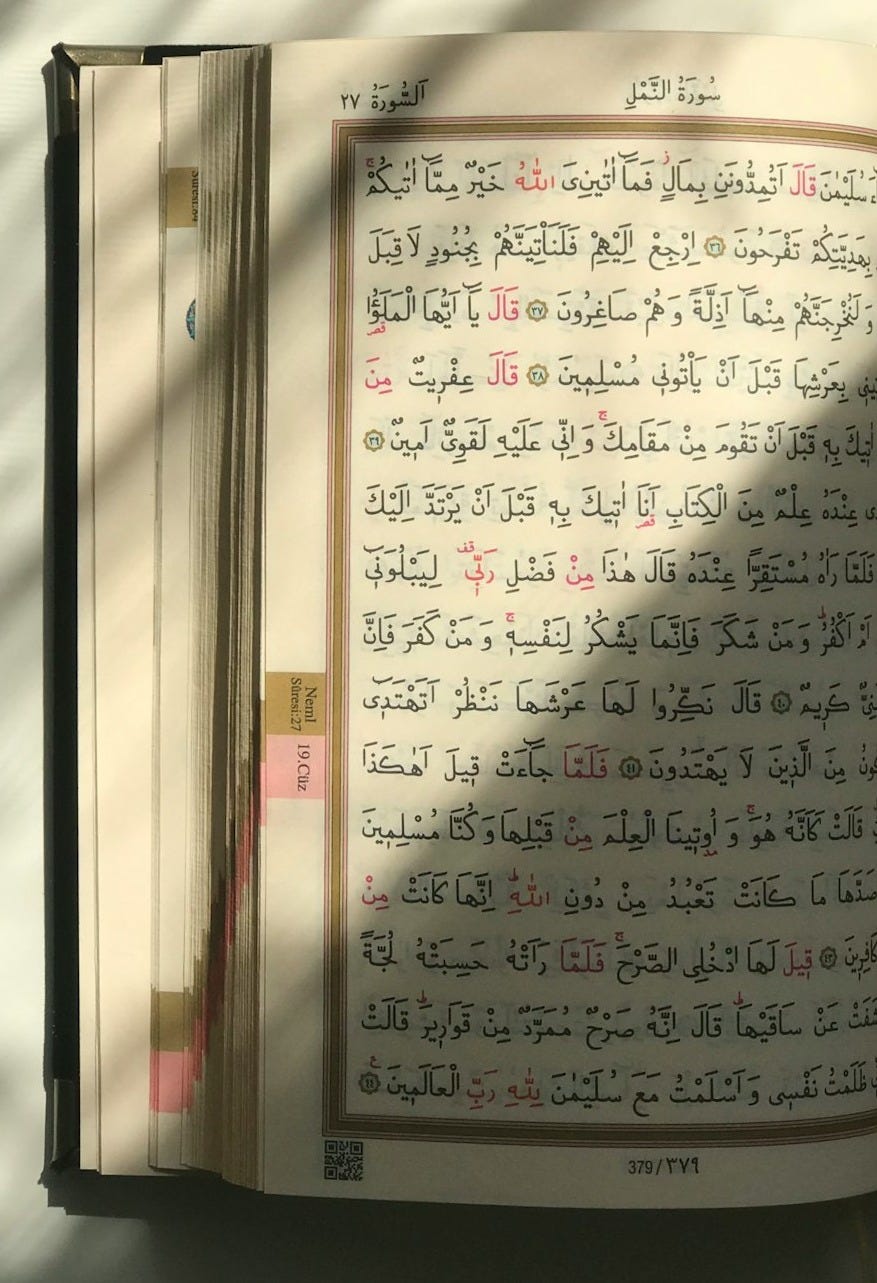
I used to think that memorizing more in one sitting meant making faster progress. So I’d sit down, push through a few pages, feel good about it, and wake up the next morning to find most of it gone.
It took an embarrassingly long time to understand why. I remember telling a teacher of mine that I was struggling, that nothing seemed to stick no matter how much time I put in. He answered with one ayah:
وَالَّذِينَ جَاهَدُوا فِينَا لَنَهْدِيَنَّهُمْ سُبُلَنَا ۚ وَإِنَّ اللَّهَ لَمَعَ الْمُحْسِنِينَ
“And those who strive for Us, We will surely guide them to Our paths. And indeed, Allah is with the doers of good.” (Al-Ankabut: 69)
So I understood. The guidance comes through the striving, not before it. You don’t wait until you find the right “way”, then begin. You begin, you struggle, and the path opens.
How do we remember things in the first place?
It’s worth understanding what actually happens in our brain when we memorize. Because once we see it, it all makes sense.
When we first encounter an ayah, our brain forms a fragile neural connection. The information exists, but sits in short-term memory, essentially a holding area. That feeling of “I’ve got it” after the first few reads is real but misleading, and it fades within minutes. What moves a memory from short-term to long-term is repeated exposure over time. Each repetition strengthens the neural pathway; the brain literally builds up insulation around it, making the signal faster and more durable. This is what's called neuroplasticity: the brain physically restructuring itself in response to what we consistently do.
The critical word is over time. Repeating something 20 times in one session doesn’t produce the same result as repeating it across multiple sessions with gaps in between. The brain needs to re-encounter the same information after a rest period to consolidate it into long-term storage. Memorization done properly (small amounts repeated deeply across days) maps directly onto how memory actually works.
Here are 6 tips to put that into practice.
Tip #1: Start with less than feels productive
When I finally committed to a serious memorization practice, I began with one ayah per session. Sometimes just one ayah or one line. It felt almost too small to count.
But Ibn al-Jazari (may Allah have mercy on him) noted that even the companions of the Prophet ﷺ would take no more than three, five, or ten verses at a time, and would not exceed that. These were people whose entire lives were oriented around the Quran. If that was their pace, it said something.
The goal in the beginning is depth and not quantity. One ayah properly locked in is worth more than half a page held loosely.
Tip #2: Repeat far more than feels necessary
This is where most people quietly lose their memorization without realizing it. They recite an ayah back a few times, feel like they have it, and move on. That initial impression is just short-term encoding, thin and temporary.
Ibn al-Jawzi wrote: “The secret behind mastering what you memorize is lots of repetition.” The Prophet ﷺ himself warned:
«تَعَاهَدُوا الْقُرْآنَ، فَوَالَّذِي نَفْسِي بِيَدِهِ لَهُوَ أَشَدُّ تَفَصِّيًا مِنَ الإِبِلِ فِي عُقُلِهَا»
“Take care of the Quran, for by the One in Whose hand my soul is, it escapes the chests of men quicker than a precious camel from its leash.” (Bukhari 5033, Muslim 791)
I would repeat a single ayah 50 or 60 times (or more) in one sitting. That number sounds excessive until you understand what’s happening: you’re triggering the biological process that moves a memory from fragile to durable. At five repetitions, the pathway is thin, but at fifty, it starts to hold.
Over time, as the memory strengthens, fewer repetitions are needed to achieve the same depth. The key is not rushing that reduction.
Tip #3: Always bridge the old and the new
Early on I made a mistake that cost me weeks. I’d memorize my new portion, feel satisfied, and move on. Then I’d discover I could recite yesterday’s section and today’s section independently, but had no idea how they connected.
The fix is to begin every session by reciting the last several ayat you already know, then continue to the new ones. If you’re doing one ayah a day, recite the previous five first. This stitches new material onto the old, so your memory has a thread to follow rather than isolated fragments.
Tip #4: Use the same copy of the Quran every time
This one surprised me when a teacher first mentioned it, but it makes sense once you think about how visual memory works. You start to recognize where an ayah sits on a page, how a certain word falls at the end of a line, what the text looks like in that spot. Your memory uses those visual anchors, even when you’re not consciously aware of it.
Keep one copy and use it every session. A different mushaf means different page layouts, and those anchors are gone. You don’t have to use the same exact physical copy, but the same print edition.
Tip #5: Read from the page regularly
There’s a tendency to treat recitation from memory as the only valid form of revision. Always close the book, always test yourself. But this puts pressure on a memory that might not be fully consolidated yet, and it can silently reinforce errors you’ll struggle to unlearn later.
Reading your memorized portions from the written page gives your brain visual reinforcement and catches mistakes you might not otherwise notice. It’s part of how solid memorization gets built, and using the same copy of the Quran helps especially here.
Tip #6: When it isn’t working, adjust, don’t stop
I had stretches where nothing seemed to stick. I’d repeat an ayah forty times and still feel uncertain about it the next morning. For a while I read that as a personal failing, maybe I just wasn’t built for this.
What I eventually understood is that struggling is information, not verdict. When memorization isn’t working, something in the method needs adjusting: the amount is too large, the repetitions aren’t spaced well enough, the session is happening at the wrong time of day. I started experimenting with smaller portions, trying during different parts of the day, reading from the page more often before testing myself, helping myself by listening to the page over and over. Some adjustments made no difference. Others changed everything.
Last thoughts
Memory grows with use. If you need 60 repetitions to lock in one ayah at the start will, months later, need far fewer. The capacity genuinely develops. What felt hard in the beginning becomes infrastructure for everything that follows.
One page done properly might take two or three weeks when starting out. That’s fine.
Start, stay consistent, and trust the process to open up as you go. The Prophet ﷺ said it simply:
«أَحَبُّ الأَعْمَالِ إِلَى اللَّهِ أَدْوَمُهَا وَإِنْ قَلَّ»
“The most beloved deeds to Allah are the most consistent, even if they are small.” (Sahih al-Bukhari 6465)